Marketing in 2026 in numbers: 12 facts from McKinsey, Gartner and The CMO Survey
Eva GarrelUpdated
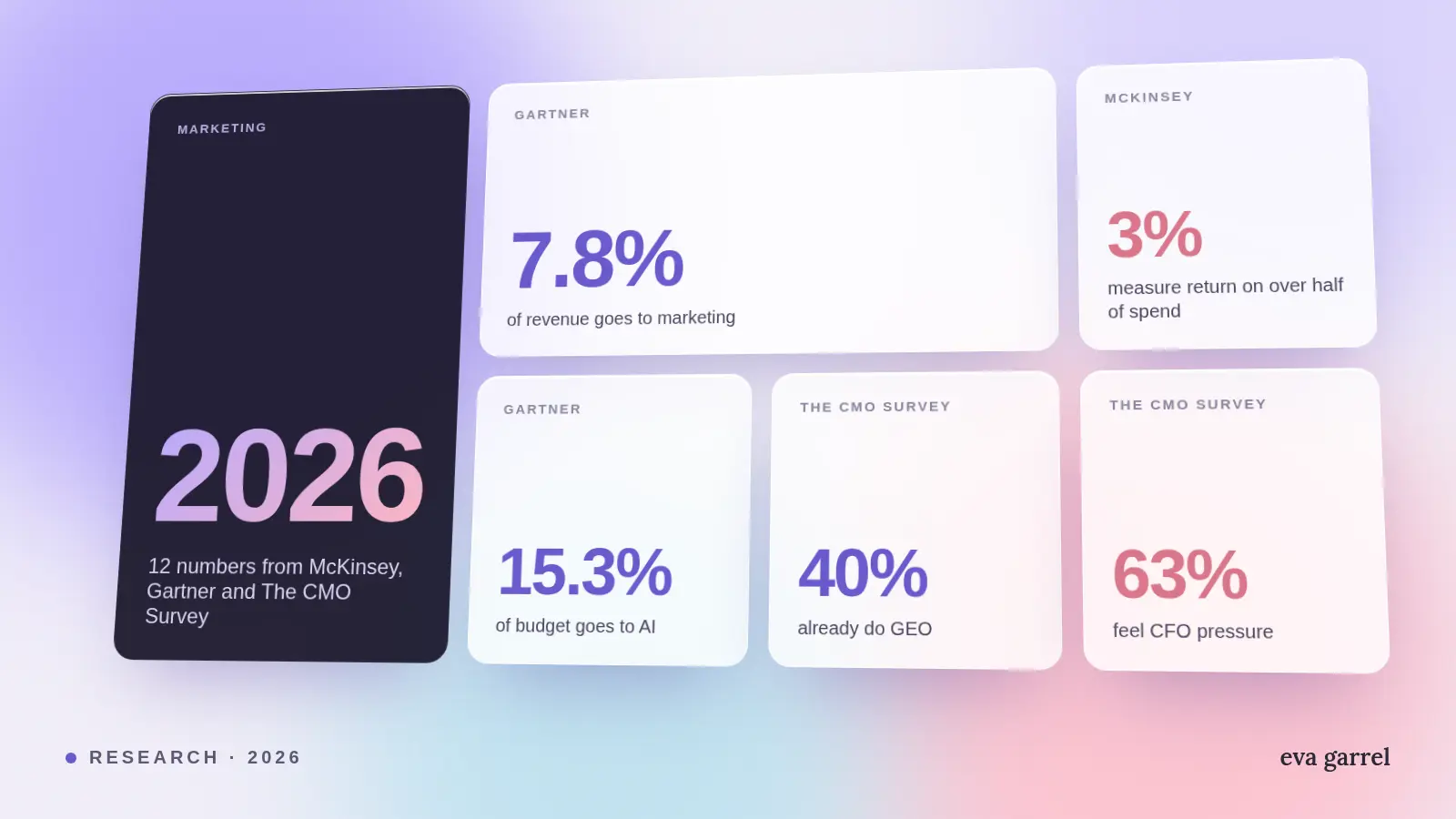
Every year large consultancies and universities survey hundreds of CMOs. The reports are thick, often gated and easy to skim past. I read the main ones and picked twelve numbers that change decisions rather than just decorating slides. Each comes with a short note on what it means for a company without an analytics department or a McKinsey budget.
Budgets: there will not be more money
1. Marketing gets 7.8% of revenue, 18% less than four years ago
That is the Gartner CMO Spend Survey 2026: 401 marketing leaders, mostly at companies with over a billion dollars in revenue. A year earlier it was 7.7%, so budgets are effectively flat.
What it means: growth can no longer be bought with money. It has to be found inside the existing budget.
2. Budgets grew by just 1.7% in a year
The CMO Survey 2026 by Duke University and Deloitte, which surveys US companies, calls this the weakest growth in several years. Marketing’s share of revenue there is 9.0%, down from 9.4% a year earlier.
- 2025
- 2026
Show the data
| Survey | 2025 | 2026 |
|---|---|---|
| Gartner | 7.7% | 7.8% |
| The CMO Survey | 9.4% | 9.0% |
3. 56% of CMOs say they lack the budget to deliver their strategy
Gartner again. More than half of marketing leaders are responsible for a plan they were never resourced for.
What it means: if marketing always feels short of money, you are not alone. The question is not how to get more but what to stop doing.
4. Yet 72% of European CMOs plan to raise budgets
In McKinsey’s State of Marketing Europe 2026 (500 leaders across five countries), 72% plan to increase budgets relative to sales in 2026, up from 49% a year earlier.
What it means: the appetite to spend is growing faster than the money. The winners will be those who can prove their money works.
5. Paid media grew to 31.4% of the budget while retention is being cut
Gartner notes the growth in paid media is funded by cutting agency costs, and that loyalty and retention investment is shrinking. The analysts themselves warn this may help in the short term but weaken growth in the long term.
What it means: buying new customers while losing old ones is pouring water into a leaking bucket. Check whether you know what a lost customer costs.
6. Over 70% of marketers put quick results ahead of long-term ones
The CMO Survey 2026. Under budget pressure, the short term almost always wins.
Measurement: marketing’s biggest weakness
7. The top challenge for CMOs is showing impact on financial results
That was the answer in The CMO Survey 2025. Growing pressure from the CFO is felt by 63%, up from 52% a year earlier. Pressure from the CEO rose from 51% to 61%, from the board from 33% to 50%.
8. Only 3% of companies can explain more than half of their marketing budget through return measurement
Perhaps the most sobering number of the year, from McKinsey’s State of Marketing Europe 2026. More than 90% of companies can explain at least a tenth of spend. Which means that for most, up to 90% of the money is spent without any measurement at all.
What it means: if you measure return on even your main channels, you are already ahead of almost everyone.
9. Only about half of CMOs work regularly with the CFO
McKinsey, same report. The people who spend the money and the people who count it meet less often than they should.
10. 70% of CEOs judge marketing by revenue and margin growth. Only 35% of CMOs call that their top metric
From McKinsey’s “The CMO’s comeback”, 2025. Two people look at the same money and see different things.
What it means: before arguing about budget, agree on a vocabulary. Which three numbers mean, to both of you, that marketing works?
AI: the money is in, the skill is not yet
11. 15.3% of the marketing budget goes to AI, but only 30% of companies are ready to scale it
Gartner 2026. In Europe, according to McKinsey, only 6% of companies rate their gen AI maturity as high. Those 6% already save more than 20%.
12. 40% of companies already optimise for AI search
The CMO Survey 2026. Customers increasingly ask ChatGPT and Perplexity for suppliers, and companies are starting to compete for a place in those answers.
What it means: if you are absent from AI answers, you will be harder to find a year from now than you are today. The time to start is while competition there is still thin.
What follows from all this
Put the twelve numbers into one thought and you get something like this. There will be no more money for marketing, and it will be held to a stricter standard. The winners will not be those who spend more but those who know what each dollar brings and can explain it to the CFO in the CFO’s language.
For a small company that is good news. To get ahead of 97% of the market on measuring return, you do not need an analytics department. You need an honest calculation of customer cost and customer value for your main channels.
In 2026 the winner is not the biggest budget but the clearest one.
I walk through how to calculate customer cost and value with an example. What a customer really costs: CAC and LTV →
If you would like to do this for your company together: Marketing the board can read →
Sources: Gartner, CMO Spend Survey 2026, May 2026; The CMO Survey, Duke and Deloitte, March 2026 and spring 2025; McKinsey, State of Marketing Europe 2026, November 2025; McKinsey, “The CMO’s comeback”, June 2025.