I checked six markets and almost never found the business itself
Eva GarrelUpdated
Last week I ran a simple experiment. I opened search and typed what an ordinary person types when they are about to spend money. Not a company name, but their own task. Six categories, all with a Russian-speaking customer.
What I found
- A fertility clinic in Tbilisi. The entire first page belongs to medical tourism aggregators. Not one clinic website.
- Dentistry and implants. At the top, two companies that have a Russian-language page with prices. Clinics with a dozen specialists and hundreds of reviews sit below them.
- A wine tour in Kakheti. The whole first page is experience booking platforms. Not one winery.
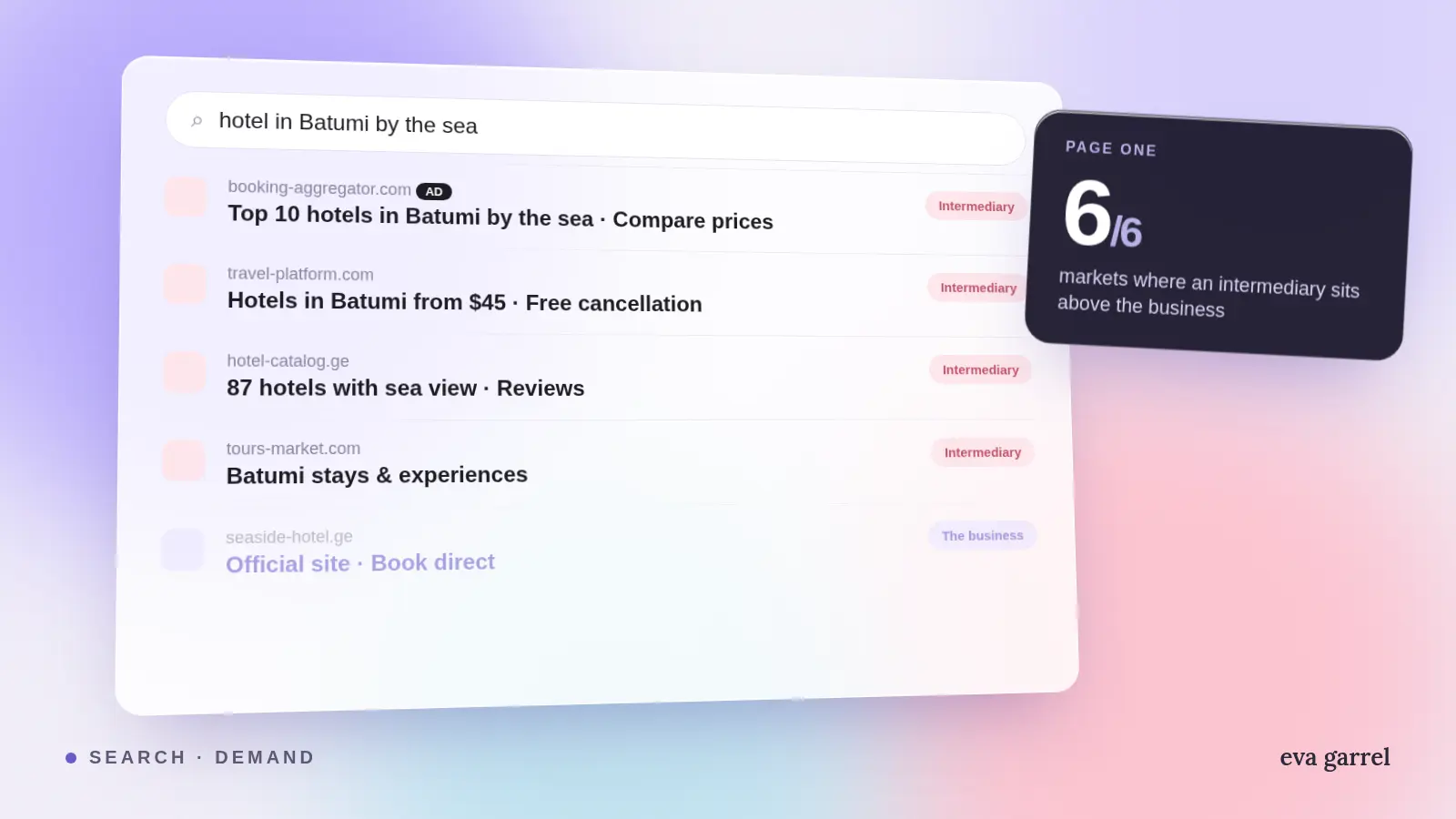
- A seafront hotel in Batumi. Six results, six booking systems. The hotel website does not appear, even when direct booking on it works.
- Company registration and residency in Georgia. At the top, Russian and international intermediaries. Local law firms are absent from the results entirely.
- Spa and massage in Tbilisi. Five results out of seven belong to a single directory, where a salon is one line among eighty-seven.
The pattern
Six different markets, different money, different customers. One picture. An intermediary stands between the business and its customer, and the business pays twice. First in commission, which is obvious. Second in the relationship with the customer, and that one is more expensive.
The guest, the patient, the client stays a customer of the platform. When they want to come back, the platform writes to them. The second order, the one that usually makes the economics work, goes there too. The worst part is that this loss is invisible. It does not appear in any report.
Why it happens
Not because of budget. Half the companies on my list have a better website than the intermediary ranking above them. The reason is different. The intermediary answers the question while the business talks about itself. People ask how much it costs, how long it takes, who will do the work and what happens if it does not work out. The aggregator answers with a table. The company website offers an About section and a contact form. In that argument, search always sides with whoever answered.
There is also an objection I have already heard. One company replied that it was happy with its visibility: good rankings, a strong maps profile, plenty of recommendations. I checked again, this time on their own company name. The first five results were platforms selling the same visit with a commission. The company website sat below them.
On its own name a business can see itself, and so it feels calm. In its own category it does not exist. And the customer who does not yet know the name searches the category.
What is changing now
All of this was already true five years ago. What is new is that people increasingly ask a chat rather than a search engine, and there the consequences are harsher. In search a business still has a chance, somewhere on the first page, lower down but visible. In an AI answer there are two or three names and no second page. Either you are named or you are not.
Then there is a technical detail almost nobody thinks about. AI crawlers do not execute JavaScript. If a site is built so that its text appears only after the browser loads it, the page is empty for them. You can open the doors in your settings and write the best possible words, they will not read them. There are more such sites than you would expect, especially among the modern and beautiful ones.
What to do about it
- Answer the customer question in their words, on your own page. How much, how long, who will run it, what is included, what is not, and who it is not for. That last point gets quoted most often, because almost nobody writes it.
- Make the direct channel the obvious choice. Platforms are useful and fighting them is pointless. But a person already standing on your website needs a reason to book here.
- Become machine readable. Check whether your text is visible without scripts, mark up services and prices, and gather the facts about yourself in a form that is easy to quote.
Check yourself in two minutes
Open search and type what your customer would type. Not your company name, but their task. Look at who ranks above you, and work out what they charge for standing there instead of you. If you do not like what you see, write to me. We will go through your search results in thirty minutes, on me.
Thirty minutes on your search results, on me. Book a free call →