A CMO one to three days a week: what it costs and when it pays off
Eva GarrelUpdated
Almost every founder knows this moment. Sales are coming in, the number of contractors keeps growing, the marketing budget is no longer small, and the person running it all is still the founder, in the evenings and between other things. Hiring a full-time CMO feels too early. Not hiring one is already expensive.
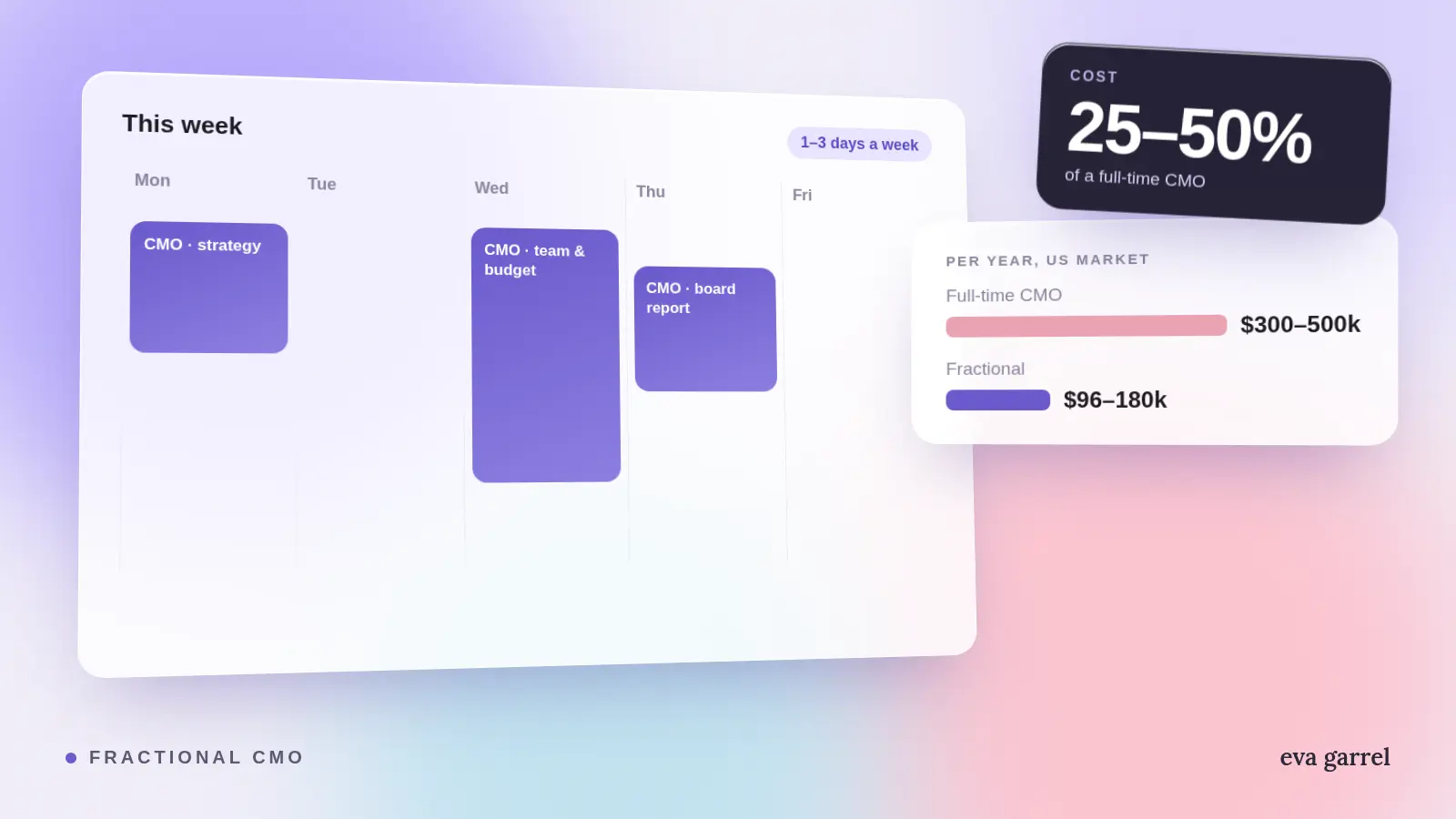
This is exactly what the fractional CMO format is for: an experienced marketing director who works with you one to three days a week. Let’s look at what it costs, what drives the price and how to tell whether it fits you.
What it costs on the market
The most detailed pricing data comes from the US, where the format has been popular for years. 2026 market reviews that combine several practitioner surveys and public rate cards converge on these ranges:
- monthly retainer from $4,000 to $20,000, most often $8,000 to $15,000;
- day rate from $1,200 to $2,500;
- hourly advisory from $200 to $500;
- one-off project from $8,000 to $50,000.
For comparison: according to Built In, average total compensation for an in-house CMO in the US in 2026 is around $294,000 a year. With taxes, bonuses and equity, the company spends $300,000 to $500,000. A fractional CMO costs roughly 20–60% of that.
Show the data
| Format | Per year |
|---|---|
| Full-time, with taxes and bonuses | $300,000–500,000 |
| Fractional, $8–15k a month | $96,000–180,000 |
In other countries the absolute numbers differ, but the logic holds. You pay for a share of the time and get the experience in full: the same person, with the same twenty years of mistakes already made on someone else’s budget.
Full-time or one to three days a week: compare for your company
Defaults are 2026 US market figures. Enter your own in any currency.
The saving only counts if a fractional CMO covers your needs. If you need someone in the office every day, hiring full-time is the honest answer.
What a fractional CMO actually does →What drives the price
Experience
According to the same reviews, someone with 10–15 years of experience charges around $5,000–8,000 a month, and someone with 20+ years $12,000 to $25,000. The difference is not in hours but in how many situations the person has already seen and knows how they end.
Depth of involvement
Building a strategy and checking it weekly is one thing. Leading a team and contractors, owning the budget and sitting in stand-ups is another. The second costs more, but it also takes far more off your plate.
Industry specialisation
A CMO who has already worked in your industry costs 20–30% more than a generalist, according to the reviews. In return, they do not spend the first month learning what makes your customer different.
How this differs from an agency or a consultant
An agency executes: it runs ads, manages social, writes copy. A consultant advises: diagnoses and leaves. A fractional CMO leads: owns the result, allocates the budget, sets tasks for agencies and people, and stays when the plan starts drifting from reality. It always does.
When the format pays off
- Sales are happening, there is a team or contractors, but no single person owns the result.
- The marketing budget is large enough that misallocating it costs more than a director.
- The founder runs marketing personally and knows their time is worth more.
- You are preparing for growth, a new market or fundraising.
When you do not need it
- There are no sales yet. A director has nothing to lead; you need a product and first customers first.
- You need someone to execute: build a site, launch ads. A good contractor will do it faster and cheaper.
- There is no appetite for change. A good director almost always proposes dropping something familiar.
How to choose well
- Ask for results in numbers: what grew, by how much and how fast. Talk about “growth strategy” in general is worth nothing.
- Ask for a 90-day plan. It shows at once whether the person is thinking about your business or their template.
- Agree on two or three metrics that will show after a quarter whether the engagement works.
- Ask how many clients they hold at once. More than four, and the “part-time CMO” becomes a CMO you cannot reach.
I work in this format myself and take no more than three or four projects at a time for exactly that reason.
In short: common questions
How much does a fractional CMO cost?
In the US in 2026 a typical retainer is $8,000 to $15,000 a month, within an overall range of $4,000 to $20,000. That is roughly 25–50% of what a full-time CMO costs.
How many days a week does a fractional CMO work?
Usually one to three days, or 10 to 20 hours a week. The scope is set to the task and reviewed every quarter.
How is a fractional CMO different from a consultant?
A consultant gives recommendations and leaves. A fractional CMO owns the result, controls the budget and leads the team and contractors.
More on what such a director does and how the first months are structured: Fractional CMO guide →
If it is not yet clear whether you need a director at all, start with one hour. Clarity hour →
Sources: market reviews by Optionality Lab (March 2026) and WebTonic (2026), combining data from Built In, Treetop, Toptal and practitioner surveys by FRAK and Duct Tape Marketing.