What a customer really costs: how to calculate CAC and LTV without fooling yourself
Eva GarrelUpdated
Sooner or later every company asks the same question: does marketing pay off? The usual answer is a report on leads, reach and cost per click. The CFO listens politely and keeps their own opinion. They are right, because leads do not pay salaries. The answer lives in two numbers, and both need to be calculated honestly.
CAC and LTV without the textbook
CAC, customer acquisition cost, is all the money spent turning someone into a customer, divided by the number of new customers in the same period. All the money means all of it: advertising, marketing and sales salaries, contractors, tools, platform commissions.
LTV, lifetime value, is the gross profit a customer brings over the whole relationship. Profit, not revenue: out of revenue you still pay for the product, delivery and people's time.
On their own, these numbers say almost nothing. An expensive customer can be profitable and a cheap one ruinous. Meaning appears only when you compare them.
How to calculate it: a worked example
Take an illustrative company selling a B2B subscription service. The numbers are invented for clarity, but the proportions come from real life.
- Over a quarter, acquisition cost 1,200,000: 700,000 on advertising, 400,000 on marketing and sales salaries, 100,000 on tools.
- In the same quarter, 40 new customers arrived. CAC = 1,200,000 / 40 = 30,000.
- A customer pays 15,000 a month at a 60% gross margin, so brings 9,000 of profit a month.
- On average a customer stays almost 14 months. LTV ≈ 9,000 × 13.8 ≈ 124,000.
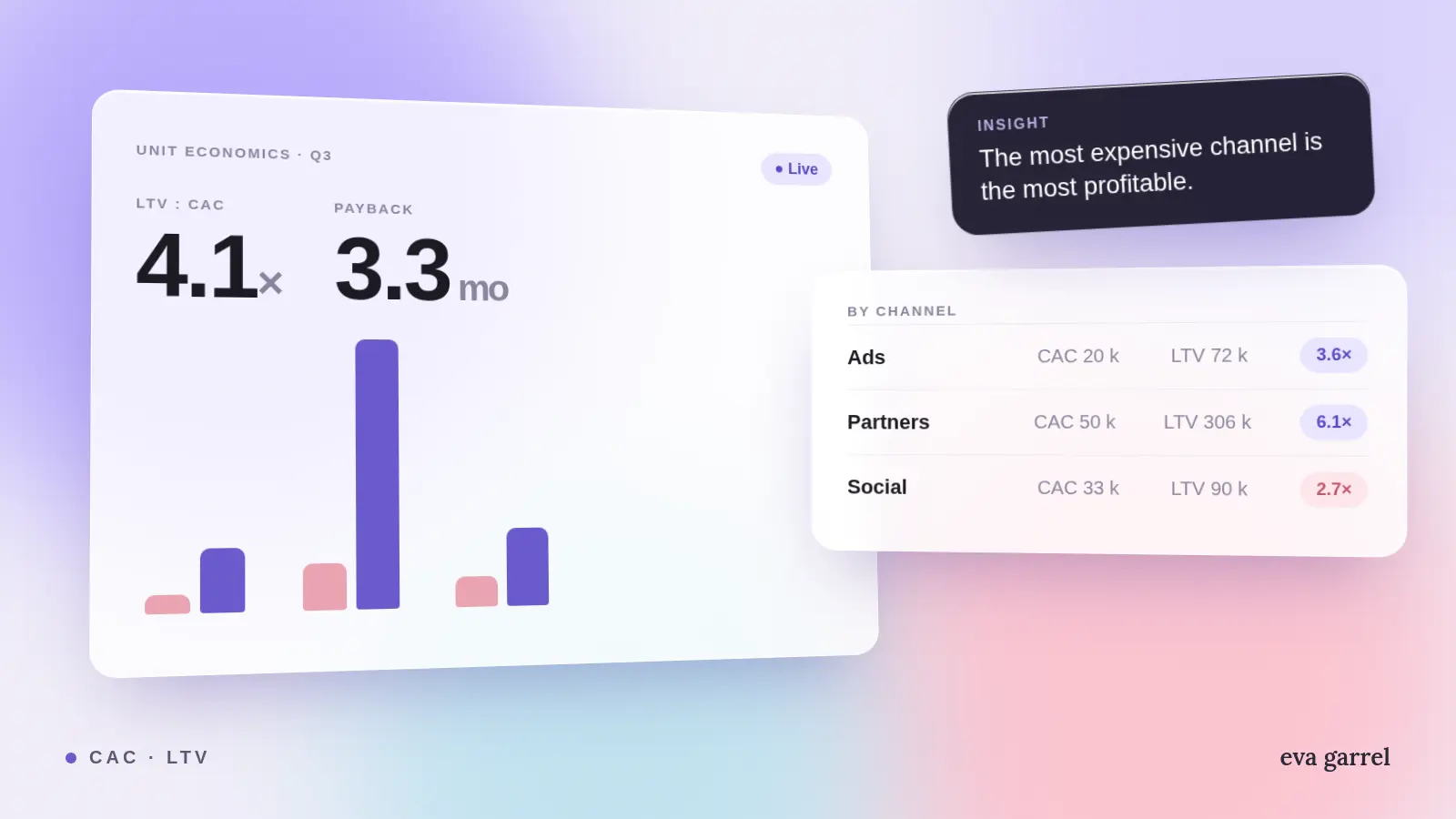
- The LTV to CAC ratio is about 4.1. Acquisition pays back in 30,000 / 9,000 ≈ 3.3 months.
Looks wonderful. Now the interesting part: split the same 1,200,000 and the same 40 customers by channel.
- Acquisition cost (CAC)
- Customer value (LTV)
Show the data
| Channel | CAC | LTV | LTV : CAC |
|---|---|---|---|
| Ads | 20 | 72 | 3.6 |
| Partners | 50 | 306 | 6.1 |
| Social | 33 | 90 | 2.7 |
The channel that looked most expensive turns out to be the most profitable. Partner customers cost 50,000 but stay for almost three years. The cheapest customers, from ads, leave after eight months. Social falls just short of a healthy ratio.
Cut the budget by cost per customer and you cut your best channel. Cut it by LTV to CAC and you cut your worst. The same table leads to opposite decisions, depending on which number you look at.
What ratio counts as healthy
The industry rule of thumb is that LTV should be at least three times CAC. It is not a law of nature, just a convenient benchmark. Below three, the company works for marketing rather than the other way round: after all costs, almost nothing is left for growth. Far above five is also worth a second look. You may be underinvesting in acquisition and leaving the market to bolder competitors.
The second benchmark is payback period: how many months of customer profit it takes to return the acquisition cost. The shorter it is, the less money is frozen in growth. Many companies aim for a year or less. Anything longer needs cash reserves and steady nerves.
Calculate your own CAC and LTV in a minute
Amounts in any currency. Defaults are the numbers from the example above.
- CAC
- 30,000
- LTV
- 124,200
- LTV to CAC
- 4.1 : 1
- Payback
- 3.3 mo
Healthy zone. Next step: calculate the same per channel, because the average may hide both the best and the worst.
Calculate it per channel together →Five mistakes that make marketing look more profitable than it is
1. Counting only advertising
Sales and marketing salaries are often larger than the ad budget. Without them CAC comes out at half its real size, and every decision rests on a pleasant illusion.
2. Calculating LTV from revenue
A customer who brought 100,000 in revenue at a 20% margin brought 20,000. A fivefold difference, and rarely in your favour.
3. Blending channels into one average
An average CAC hides both the best channel and the worst, as in the example above. Averages are good for reports and bad for decisions.
4. Forgetting about time
If a customer pays back in two years but the ad money is needed now, a beautiful ratio will not save you from a cash gap.
5. Calculating it once
Acquisition cost changes every quarter with the auction, the season and the competition. A year-old number describes a different company.
Why this matters especially in 2026
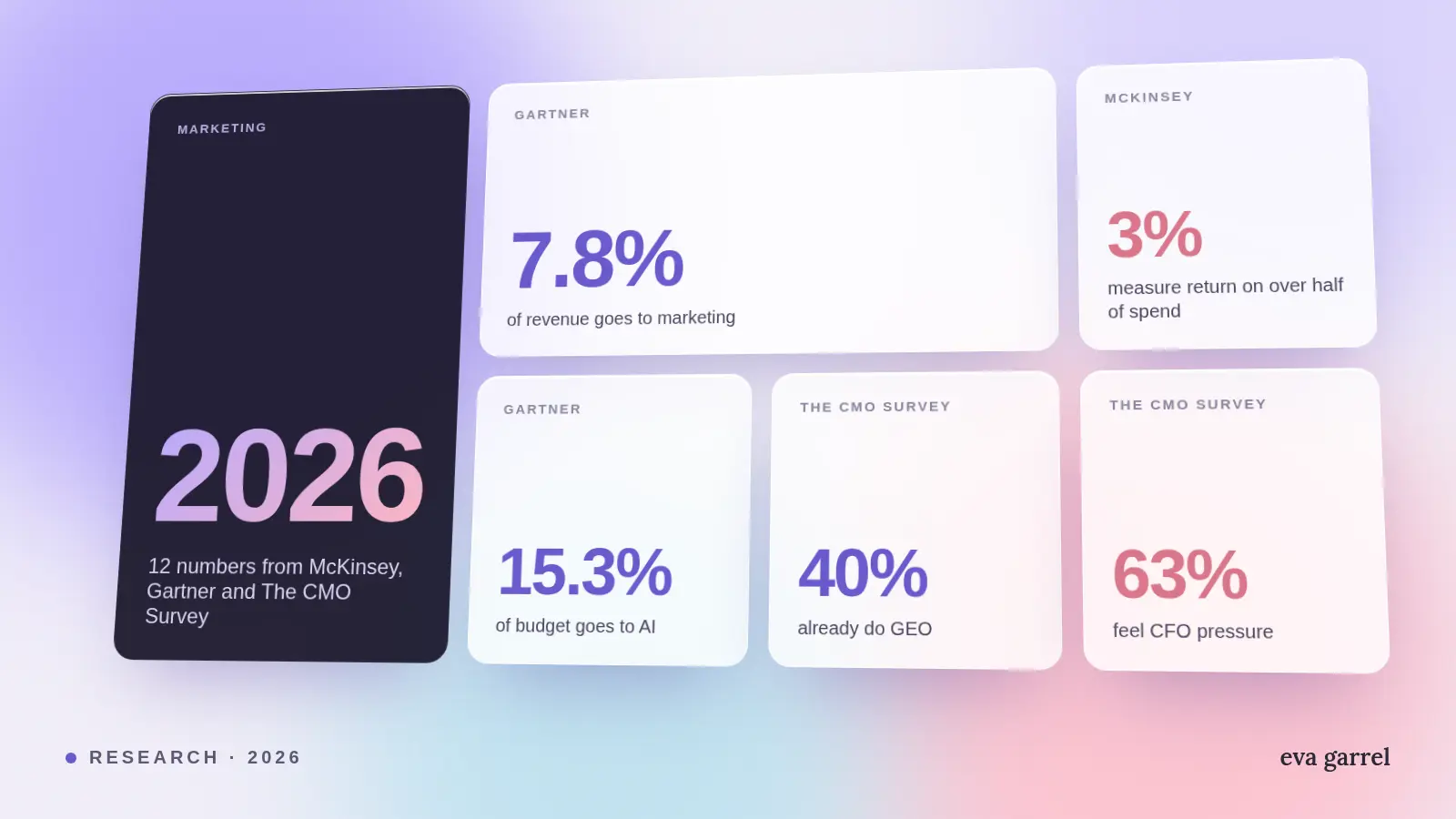
According to Gartner, in 2026 companies are pushing paid media up to 31.4% of the marketing budget and cutting investment in retention and loyalty to fund it. New customers arrive today; the bill for the ones who leave arrives later. Without LTV, that bill is simply invisible.
McKinsey offers an example that shows the price of this blindness. A hospitality company spent more than $100 to acquire each guest, while a guest brought in $80 on average. The advertising worked beautifully, guests kept coming, and each new guest made the company a little poorer. Nobody noticed, because everyone was counting guests rather than their price.
There are more such companies than it seems. In McKinsey’s State of Marketing Europe 2026, just 3% of companies could explain more than half of their marketing budget through return measurement. The rest spend most of their money without knowing what it brings.
What to do if the numbers are unpleasant
Do not panic and do not cut everything. An unpleasant number is not a verdict but a map: it shows exactly where the money leaks.
- If CAC is high, look at the customer path after the enquiry. Money is often lost not in advertising but in slow replies and weak selling.
- If LTV is low, look at retention. Keeping an existing customer is almost always cheaper than finding a new one.
- If one channel is bad, shrink it and move the money where the ratio is better. Check the result after a quarter.
In short: common questions
How do you calculate CAC?
Add up all acquisition costs for a period, including advertising, marketing and sales salaries, contractors and tools, and divide by the number of new customers in the same period.
How do you calculate LTV?
Multiply the average monthly gross profit per customer by the average time a customer stays. For one-off purchases, use the average number of purchases instead of time.
What LTV to CAC ratio is good?
A common benchmark is 3 to 5. Below three, acquisition eats almost all the profit; far above five, you may be underinvesting in growth.
Marketing makes sense to a CFO the moment it starts talking about customers in money rather than in leads.
Calculating this for your company, channel by channel, takes two to three weeks. Marketing the board can read →
Sources: McKinsey, “The CMO’s comeback”, June 2025; McKinsey, State of Marketing Europe 2026, November 2025; Gartner, CMO Spend Survey 2026.