AI in marketing: where it pays off and where it only looks busy
Eva GarrelUpdated
Everyone is implementing AI in marketing right now. In meetings it sounds like “we already use AI”, in reports like “we halved the time spent on content”. Yet in profit, somehow, nothing shows. This is not a hunch; it is what the research says.
What the numbers say
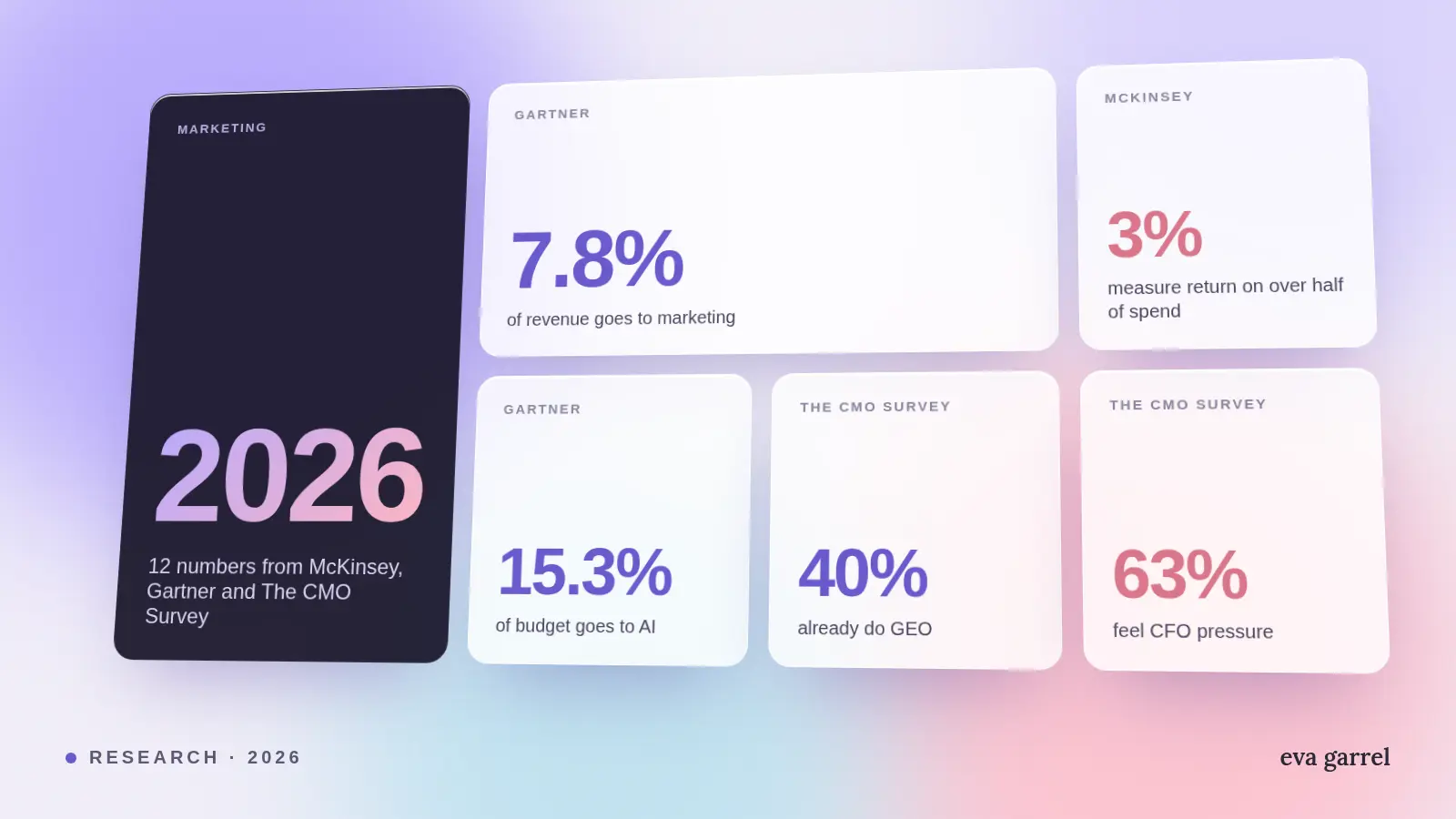
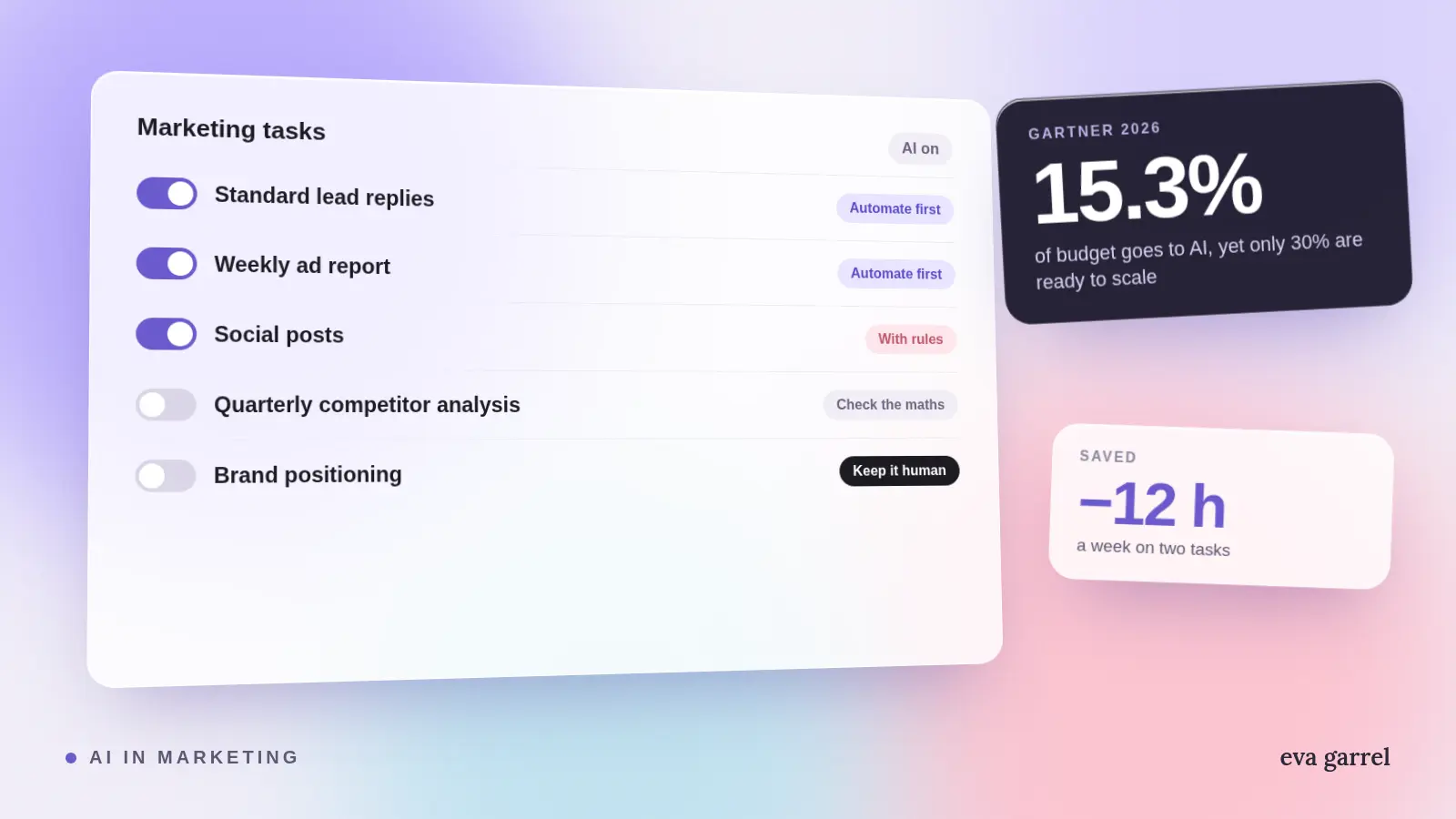
According to Gartner, in 2026 CMOs put an average of 15.3% of their budget into AI. Yet only 30% consider themselves ready to scale these initiatives, and 70% admit their processes are not mature enough.
Europe looks similar. In McKinsey’s State of Marketing Europe 2026, only 6% of marketing leaders rate their company’s gen AI maturity as high. Those 6% already save more than 20% and reinvest the savings in growth.
In 2025 MIT researchers reviewed more than three hundred generative AI deployments and reached an uncomfortable conclusion: most pilots never produced a measurable impact on profit. The 95% figure was widely disputed afterwards. What separates the projects that work was disputed much less.
Why most deployments bring no money
In the MIT research, successful projects are tied to three things: a specific workflow, a measurable outcome and a person accountable for that outcome. Unsuccessful ones lack at least one.
In marketing it looks like this. Every employee uses ChatGPT in their own way. One writes posts, another emails, a third pulls reports together. There are savings, but they stay in the employee’s personal time and never reach the business. Nobody knows how many hours were saved, where they went or whether the result got better. That is what looking busy means: the effort is real, the return is not.
A simple check: four zones
Before implementing anything, ask two questions about every task. How often does it repeat? And can its result be measured in money or time? The answers sort all tasks into four zones.
Automate first. Savings are easy to count and mistakes easy to spot. Start here.
Frequent and measurable: automate first
First-line lead handling and answers to standard questions, reports combined from several systems, ad variants for testing. Savings are easy to count and mistakes easy to spot.
Frequent but hard to measure: automate with rules
Social posts, newsletters, product descriptions. AI speeds things up, but quality drops quietly. You need rules: a brand voice, human review, no publishing without editing.
Rare but measurable: check the maths
Quarterly competitor analysis, a database segmentation twice a year. It can be automated, but the savings are modest. Sometimes it is cheaper to leave it as it is.
Rare and unmeasurable: keep it human
Strategy, positioning, deciding what to stop doing. Here AI is a good conversation partner and a bad boss. It will offer ten options but cannot choose for you.
Should this task go to AI?
Answer two questions and a recommendation will appear here.
Where AI only looks busy
- Content for volume. A hundred posts a month instead of twenty looks like growth, but it does not add readers.
- Dashboards nobody opens. Building a report got cheap, but decisions still are not made from it.
- Chatbots with no handover to a human. A customer with an unusual question leaves, and the statistics record a “handled enquiry”.
- AI adoption as a project with no owner. When everyone is responsible for the result, no one is.
A new zone many forget about
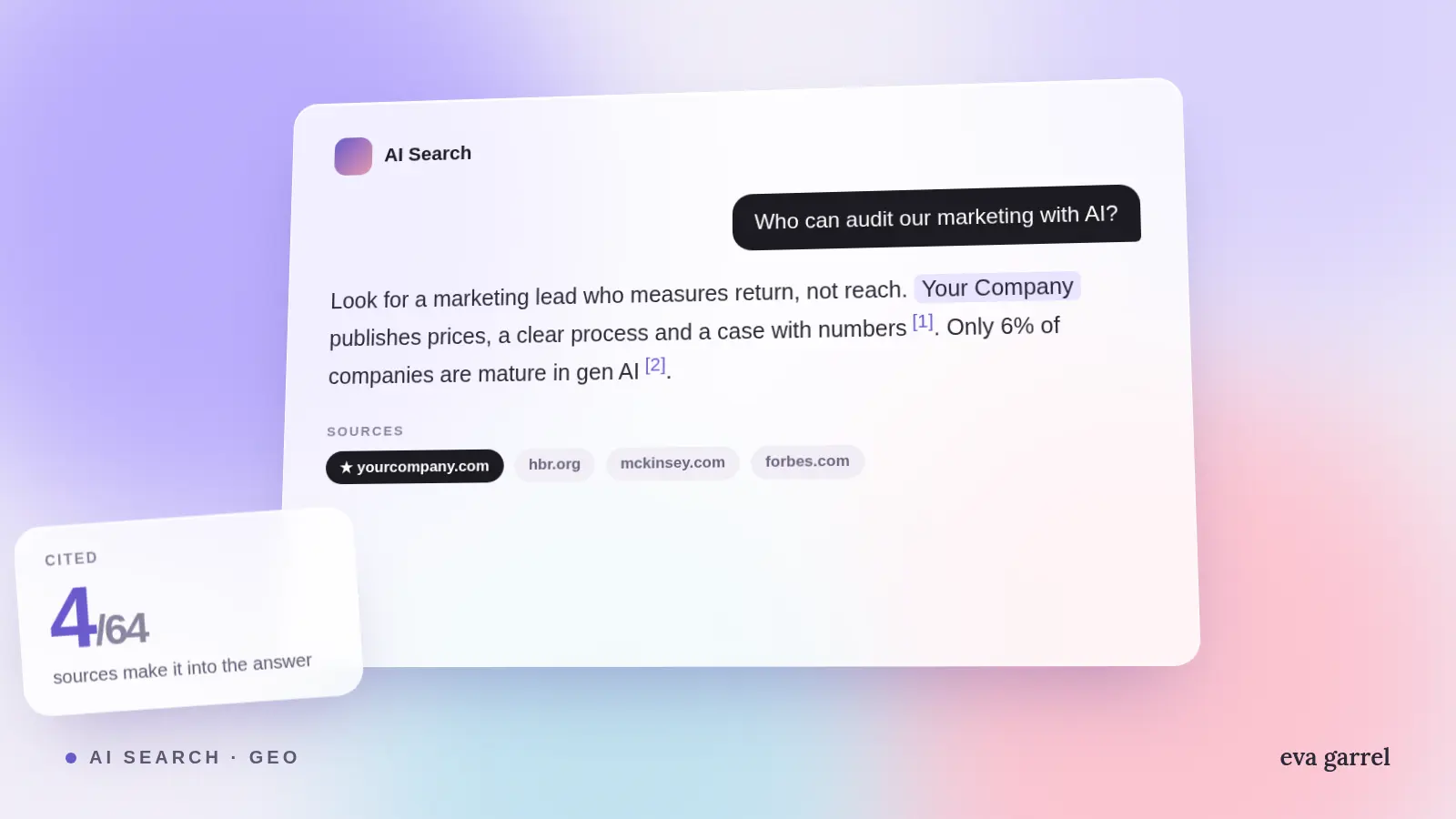
AI is no longer just a tool inside the company; it is also where customers look for suppliers. People ask ChatGPT and Perplexity whom to choose, and the models answer by naming specific companies. According to The CMO Survey 2026, 40% of companies already practise generative engine optimisation (GEO). The rest are leaving that space to competitors for now.
I covered how visibility in AI answers works and what to do about it separately. Visibility in AI search →
Where to start this week
- List ten marketing tasks that repeat every week and how many hours each takes.
- Pick two that fall into the “frequent and measurable” zone.
- Give each an owner and one metric. After 30 days, compare with before.
You recognise a good AI deployment not by the number of tools but by someone being able to say how much money it saved last month.
If you want this done across the whole marketing chain with the savings calculated, it takes two weeks. AI marketing audit →
Sources: Gartner, CMO Spend Survey 2026, May 2026; McKinsey, State of Marketing Europe 2026, November 2025; MIT Project NANDA, “The GenAI Divide: State of AI in Business 2025”; The CMO Survey, Duke and Deloitte, March 2026.